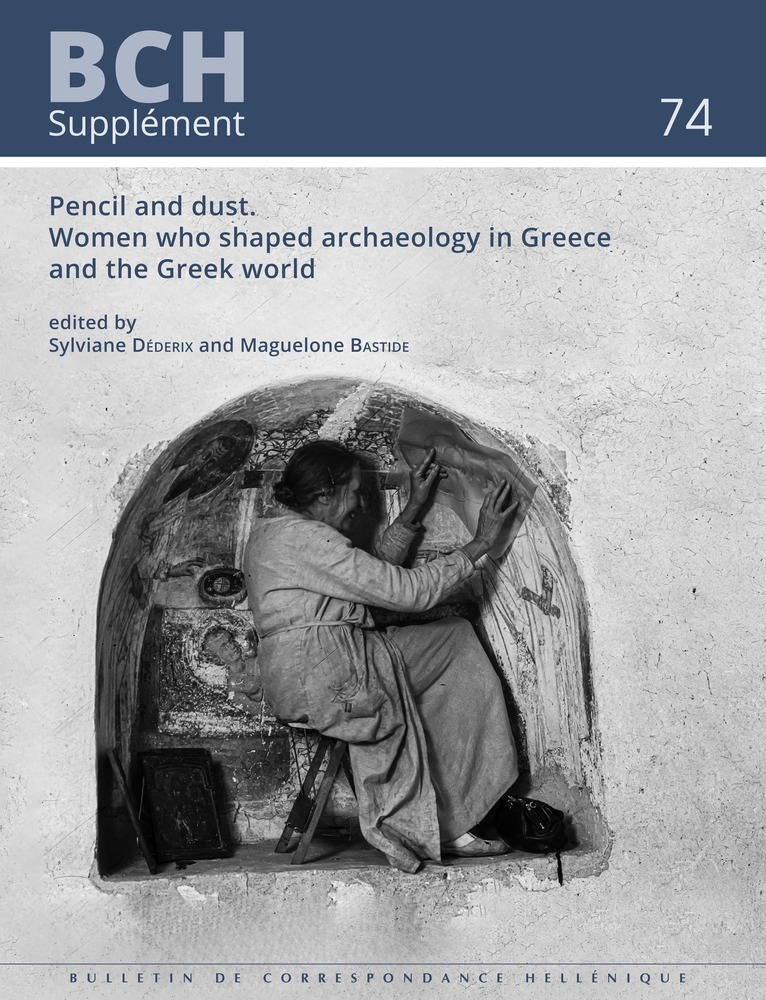
The history of archaeology – particularly Classical archaeology – has long been written as a men’s story, obscuring the crucial role played by women. Focusing on Greece and the wider Greek world, Pencil and dust restores women’s place in historiography by highlighting their contributions to excavations, the study of finds, and the development of methods and theory.
The professionalisation of archaeology in the late nineteenth century brought about the marginalisation of women, who were relegated to the role of skilled but invisibilised – and unpaid – assistants. Yet pencil in hand, they recorded, drew, corrected, and refined archaeological knowledge. As their access to education expanded, women gradually claimed new spaces, from storerooms and museums to the field itself. Hands in the dust, these pioneers challenged gender norms while facing resistance and institutional barriers.
Through biographical and thematic case studies, this volume brings their fragile, often erased legacy back into view and contributes to a more inclusive history of archaeology.
Sylviane Déderix, a former Belgian member of the École française d’Athènes, holds a PhD in History, Art and Archaeology from UCLouvain and is currently based at the University of Warsaw. She directs the prehistoric team of the Thorikos Archaeological Research Project (EBSA) and oversees the study of legacy data from the Bronze Age necropolises of Malia (EFA).
Maguelone Bastide holds a PhD in History and Archaeology of the Ancient Worlds (Université Paris Nanterre). A former member of the École française d’Athènes, she is currently an associate member of the team Archaeology of the Greek Worlds (UMR 7041 ArScAn). She directs the study of Early Iron Age ceramics in Thasos and contributes to research projects in Bulgaria.
Longtemps, l’histoire de l’archéologie – en particulier de l’archéologie classique – s’est écrite au masculin, reléguant dans l’ombre le rôle essentiel des femmes. Centré sur la Grèce et le monde grec ancien, Pencil and dust restitue leur place dans l’historiographie en mettant en lumière leurs contributions aux fouilles, à l’étude des vestiges et à l’élaboration des méthodes et des cadres théoriques de la discipline.
La professionnalisation de l’archéologie à la fin du xixe siècle a renforcé la marginalisation des femmes, les cantonnant à des fonctions d’assistantes qualifiées mais invisibilisées – et souvent non rémunérées. Crayon à la main, elles ont pourtant participé activement à la production du savoir. Peu à peu, elles ont investi les réserves, les musées, puis le terrain. Les mains dans la poussière, ces pionnières ont défié les normes de genre en affrontant la résistance et les obstacles institutionnels.
À travers des études de cas biographiques et thématiques, cet ouvrage redonne visibilité à ces trajectoires longtemps effacées et contribue à une histoire plus inclusive de l’archéologie.