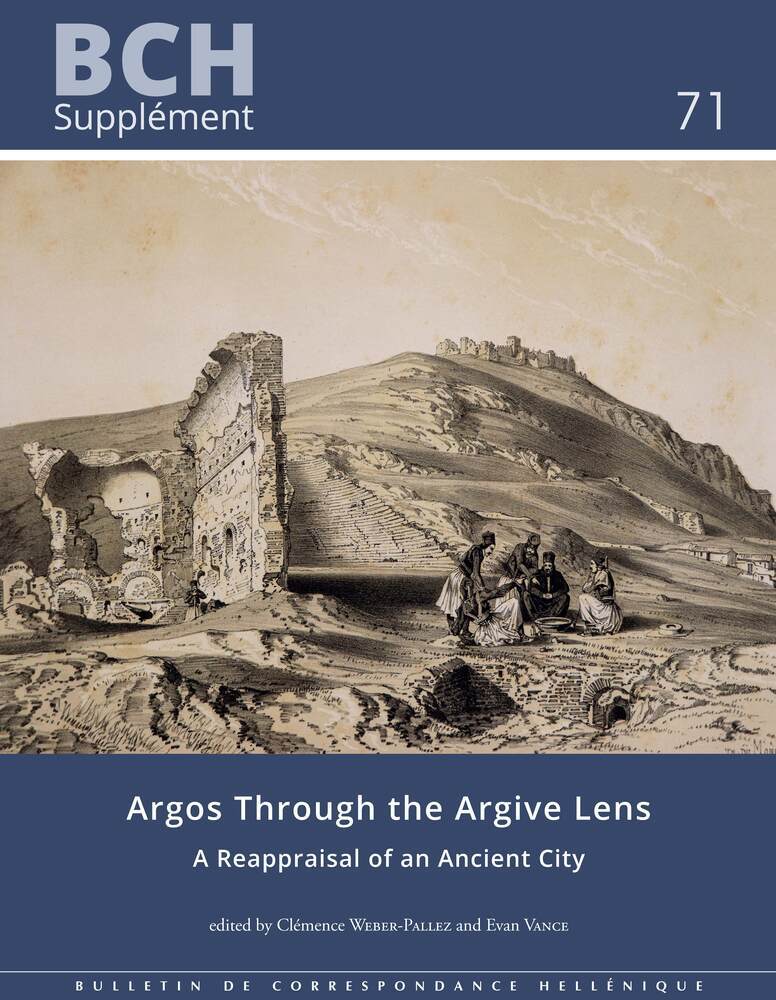
Argos was one of the most important cities in ancient Greece—if we follow Isocrates and Strabo. However, it has generally been studied as a secondary participant compared to its more important neighbours like Athens and Sparta. This work places Argos centre-stage and attempts to see the Greek world through Argive eyes. In this volume, top specialists of Argos analyse an array of evidence (including archaeological, epigraphic, and literary, among others) using new methodologies and recent research to grant Argos its full weight. Studies traverse the local, regional, and Mediterranean scales, from the Archaic to the Imperial period, and emphasize Argos’ interactions with different actors, from the small komai (villages) of its territory to the greatest powers of the Mediterranean, such as the Macedonians and Romans, to ensure its hegemony over the northeast Peloponnese.
Clémence Weber-Pallez is an associate professor at Toulouse Jean Jaurès University, a member of the PLH laboratory (ARTEMIS team), and a former member of the French School at Athens. She is a specialist in Argos and the Argolid: she wrote her thesis on territorial representations of the Argolic peninsula in the Archaic and Classical periods (ENS de Lyon) and continued her research as member of the EFA with a dissertation on the integration of Argos into the Roman Empire.
Evan Vance is an assistant professor in History and Classical Studies at McGill University, where he holds the MacNaughton Chair in Classics. He received his PhD from the University of California, Berkeley in 2022 and subsequently spent two years as a post-doctoral fellow at the American School of Classical Studies at Athens. His dissertation studied sacred wealth and institutional development in the Argolid and adjacent regions, a research agenda that he now expands to the wider archaic Greek world.
Argos était une des plus importantes cités de la Grèce antique, si l’on en croit Isocrate ou Strabon. Pourtant, elle est toujours étudiée comme une actrice secondaire, au profit de ses grandes voisines d’Athènes ou de Sparte. Cet ouvrage a pour ambition de placer Argos au premier plan et d’envisager le monde grec à travers les yeux des Argiens. Les plus grands spécialistes de cette cité reprennent ici l’analyse des sources (archéologiques, épigraphiques, de la tradition manuscrite, etc.) grâce à de nouvelles méthodologies ou présentent le résultat de nouvelles recherches. Ce travail permet de redonner à Argos tout son poids à l’échelle locale, régionale et méditerranéenne, de l’époque archaïque à l’époque impériale, en insistant sur les interactions que la cité a mises en place avec différents acteurs, des petites kômai de son territoire aux peuples dirigeant la Méditerranée (Macédoniens, puis Romains), afin d’assurer son hégémonie sur le nord-est du Péloponnèse.